

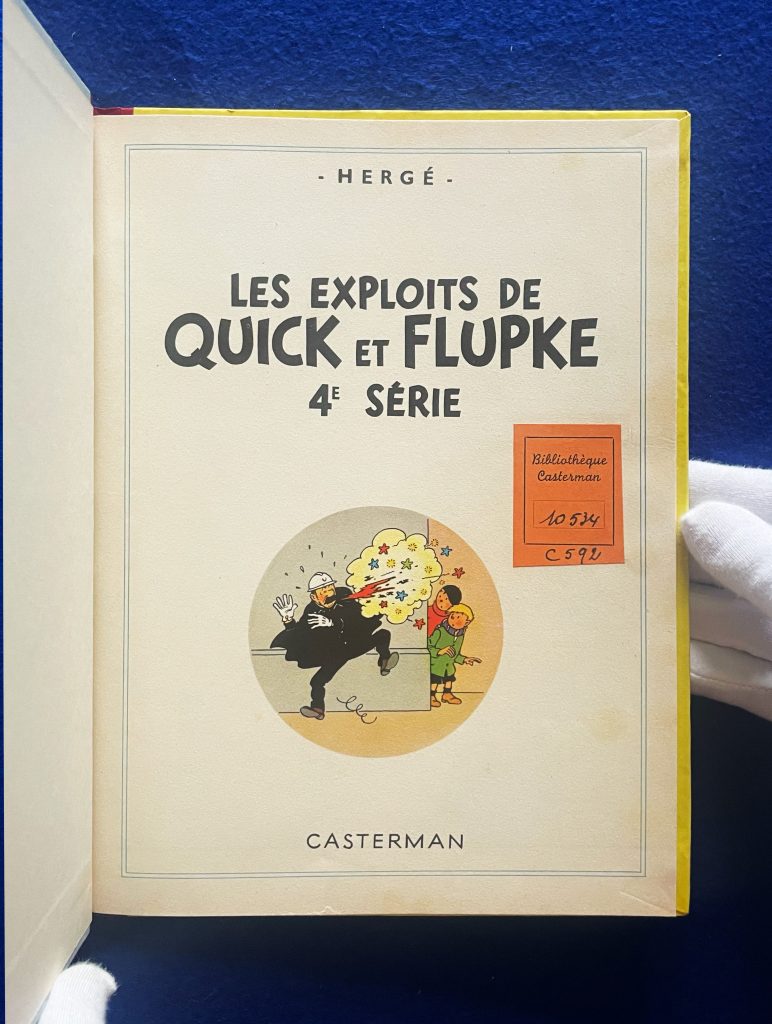
Quick and Flupke: a superb drawing by Hergé (1950) for a title page


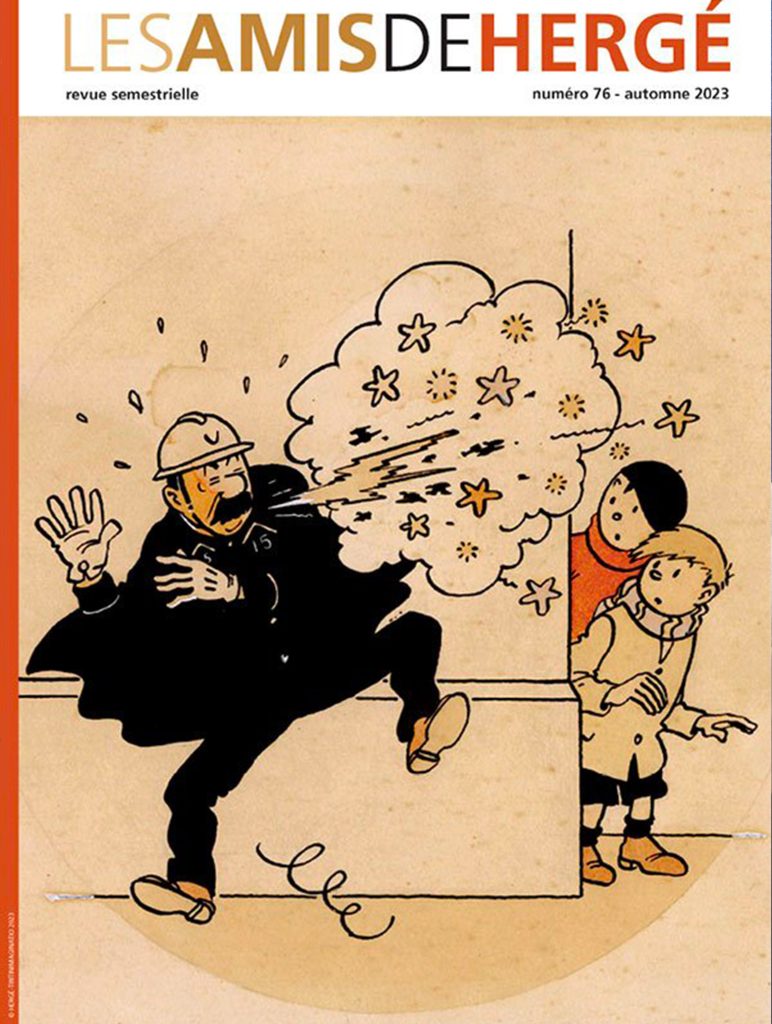


This November 2023, beile.fr is offering the original of a superb illustration that Hergé produced in 1950. This is an opportunity to look back at the colour reissue of The Exploits of Quick and Flupke after the war, and particularly on the fourth volume of this collection.
It was at the beginning of 1930 that Quick, a kid from Brussels, made his first mischievous appearances in Le Petit Vingtième. He was soon joined by Flupke. Five black and white albums were published between 1930 and 1940, the first two by Éditions du Petit Vingtième, the others by Casterman.
In October 1946, Louis-Robert Casterman decided that the time had come to reissue the Quick and Flupke stories in colour. In the months that followed, he and Hergé thought about what the collection would look like. The size of the albums (smaller than a Tintin) and the number of pages were discussed at length. In autumn 1947, Casterman finally opted for 36 pages, or 16 or 17 gags per volume.
Hergé had redrawn some episodes of Quick and Flupke at the beginning of the war for the Flemish newspaper Het Algemeen Nieuws other old gags have recently been brought to life in colour for the weekly magazine Tintin. This material will be used for the forthcoming collection, but these and other plates still need to be reworked. For retouching and colouring, Hergé was helped by Guy Dessicy, whom he had recently hired. He was joined at the beginning of 1948 by Édith Laudy and Frans Jageneau. Marcel Dehaye, the artist's private secretary, wrote the dialogue. Lastly, Hergé designed the covers and the decorative capitals illustrating the title pages.
The first two volumes of The Exploits of Quick and Flupke were released in 1949. The 3th series was published in 1950. The small team had their work cut out for them. Prisoners of the Sun and In the land of black gold are now available in bookshops, and the format of Popol and Virginie and Stratonef H. 22 is underway. We are also working on the fourth volume of Quick and Flupkewhich Casterman published in the spring of 1951. The next six volumes appeared regularly until 1961, and after many years of waiting, an eleventh volume closed the collection in 1969.
But before returning to the 4th series from The Exploits of Quick and Flupke - that's the one we're interested in here - let's take a diversion and look at Tintin. As effective as film posters, the covers of the adventures of the reporter with the quiff often present a moment chosen by Hergé from the story in question, but this is not always the case. For example, on the first cover of Cigars of the Pharaoh in colour (1955), Tintin and Snowy stumble across three vitolas as they walk along a row of sarcophagi. In the story, the reporter actually finds the cigars in crates stored in another room. Hergé has thus synthesised various elements of a long sequence into a single image. The cover of the Blue Lotus evokes China, but not the opium den where Tintin is supposed to be when he hides in a vase, and so on.
Street corners
Hergé did the same with Quick and Flupke. The cover of the 4th series is an almost faithful reminiscence of one of the gags in the album, "Mauvaise rencontre". The two boys are sledging on a snow-covered pavement when they knock down a bearded man. In his fall, the bearded man takes the place of the blond boy, who runs behind without being able to catch up with his accomplice. On the cover, Hergé has reversed the scene for the sake of legibility, as it has been decontextualised. Agent 15 now moves from left to right. The artist has also cropped the scene and added a little wink: only the lower part of Flupke's body is visible, but he is easily recognisable by the green colour of his jacket.
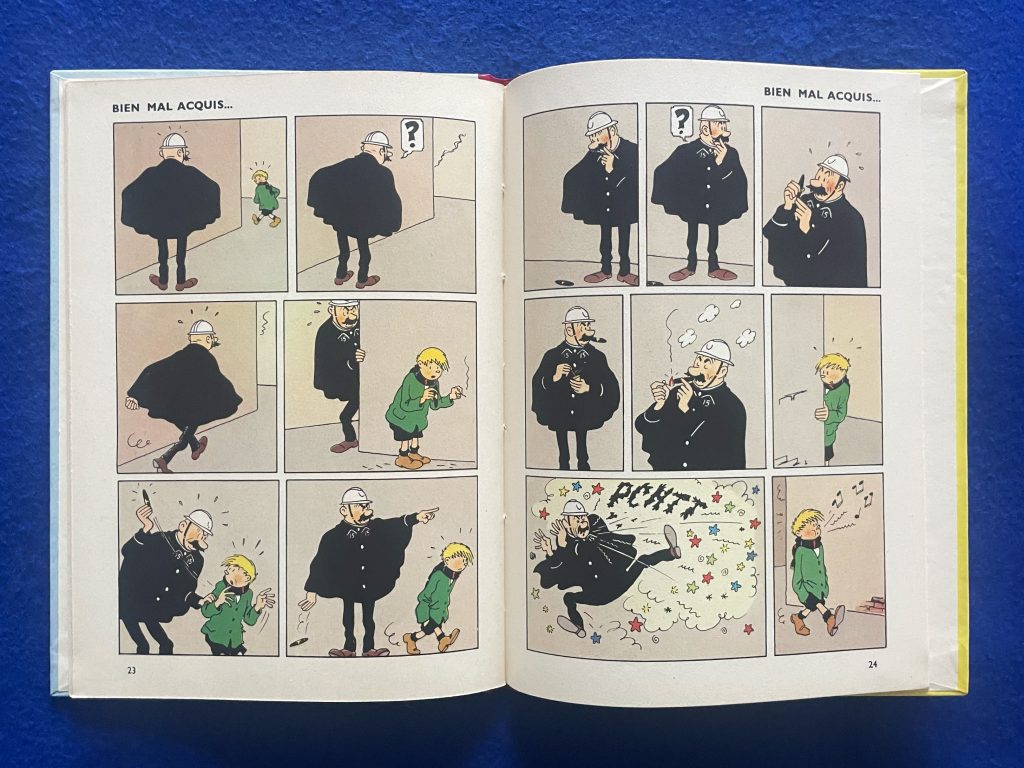
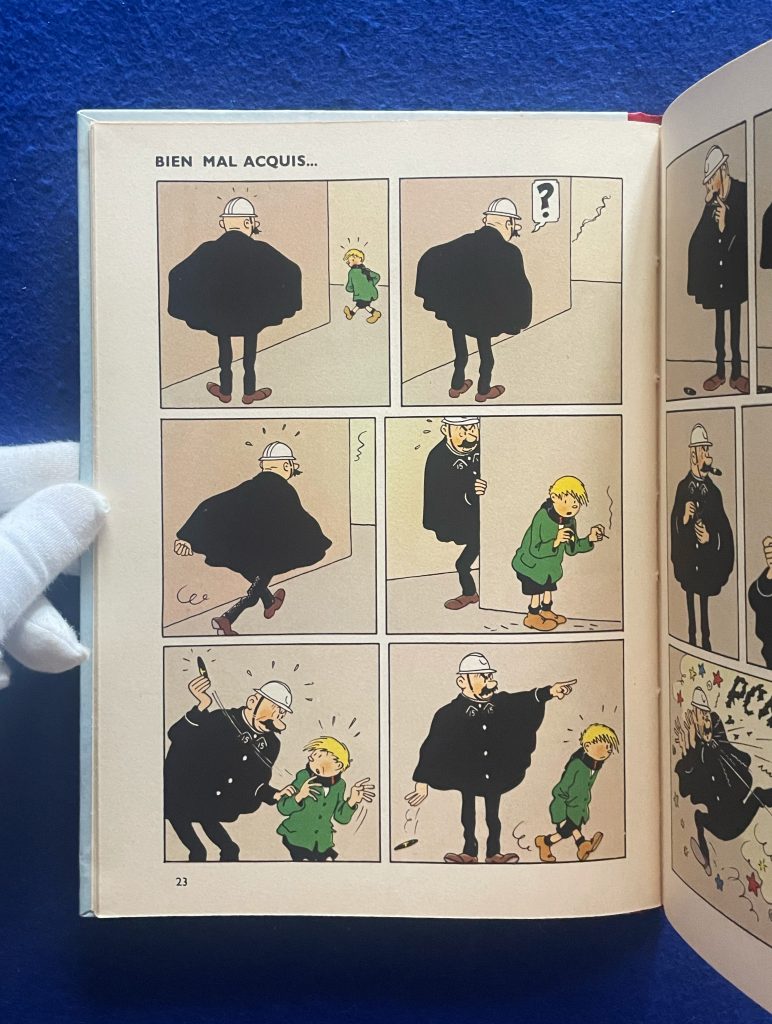
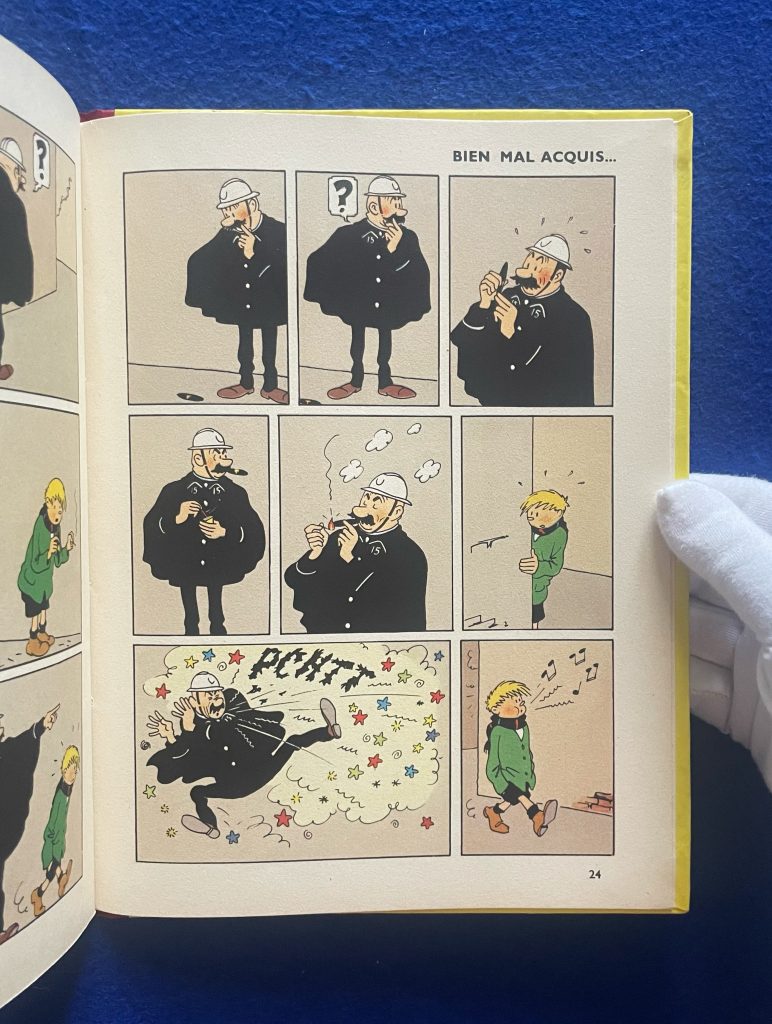
The original of the caption on the title page was inspired by "Bien mal acquis...", another gag in the album. In these two panels, Flupke - who, let's not forget, is a child - is sneaking a smoke on a street corner. But Constable 15 catches him, confiscates his cigar and makes it his own. He relights it, takes a few puffs... and the cigar explodes. Hidden behind the wall, Flupke hadn't missed a thing. He whistled away, satisfied: his objective had been to trap the police officer.
A street corner is useful in film or comics to make a character suddenly appear or disappear, to give him the opportunity to spy without being seen, or to provoke a fortuitous and spectacular encounter. Hergé used this device on numerous occasions; we have just seen two examples. We also remember Didi watching over Tintin from a distance (The Blue Lotus), Huascar's English style on page 20 of the Temple of the Sunor the telescoping of Haddock and Alcazar at the beginning of Coke in stock.
The frontispiece to volume 4 of Quick and FlupkeHergé retained the scene in which the cigar is smashed in the policeman's face. Here again, he changed the scene slightly: Flupke was no longer alone but accompanied by Quick. Like the cover, this introductory image was intended both to announce one of the volume's gags and to summarise the spirit of the series. Another difference between this image and the one in the album is that Flupke no longer seems to be totally delighted by the good turn Agent 15 has fallen victim to. His slight smile is mingled with astonishment, as if he didn't really have anything to do with it. His companion also looks rather surprised. Perhaps Hergé didn't want to give away too much of the punchline? What's more, the two boys aren't exactly hiding: readers should be able to recognise them straight away when they open their books!
Hergé at the top of his game
The gag "Bien mal acquis..." was originally published in Le Petit Vingtième No 43 of 24 October 1935. The line is vivid, reflecting a certain spontaneity on Hergé's part. He hardly touched up the two plates when they were republished in the weekly magazine Tintin in 1949, nor for the colour album. The 1950 cul-de-lampe was more thoughtfully designed. The Brussels artist was at the peak of his art: the line was precise, more 'cerebral', and the faces of the characters were framed by a perfect curve.
This Indian ink illustration by Hergé (produced on paper measuring around 17 cm square) has been enhanced with watercolour and gouache colours. We owe them to Guy Dessicy, who worked as a colourist for Hergé and other artists at the magazine. Tintin until 1953. Surprise and coincidence, the same original drawing was reproduced on the cover of the magazine Friends of Hergé n° 76, published in autumn 2023!