

The intriguing Arumbaya fetish
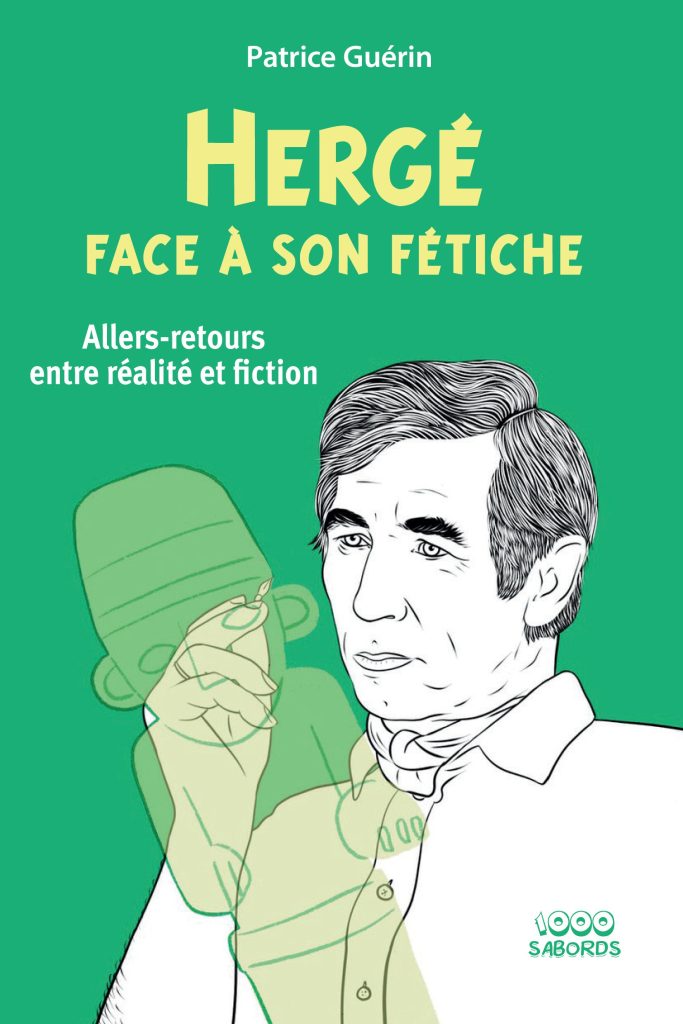


Published by 1000 Sabords (L'Harmattan group), Patrice Guérin's new book, Hergé and his fetishwas released in bookshops a few days ago. We asked him to tell us why he became interested in the famous Arumbaya statuette.
It all started in 2015. Once a year, I deliver one or two articles to Colorado beetles!the magazine of the tintinophile association Le Cercle Archibald. This time, I wanted to investigate a theft that actually took place at the Palais des Beaux-Arts in Brussels in 1979. An exhibition, Tintin's imaginary museumIt had been erected there to mark the 50th anniversary of Hergé's work. One afternoon, before the astonished eyes of a few visitors, a man seized the Arumbaya fetish belonging to Hergé, before making off with it. Reality had almost caught up with the story of The Broken Ear !
For several years, the flight was occasionally mentioned in passing in articles, books or broadcasts. But the funny thing is that from time to time, a number of often very funny twists and turns have brought the event back to the fore.
I had the idea of gathering all this scattered information and interviewing the witnesses and players in the case. This is how I was able to gather the testimonies of the hergeologists Benoît Peeters and Philippe Goddin, as well as the artist Juan d'Oultremont, Wilbur Leguebe, director at RTBF, Thierry Smolderen and a few others. Alain Baran, Hergé's last secretary, very kindly granted me an interview via Skype. I had also sent a letter to Pierre Sterckx, a friend of Hergé's who was behind the Imaginary museum. I then learned that he was very ill and unable to answer my questions; unfortunately he died shortly afterwards.
In 2016, a few months after the publication of my survey in Colorado beetles!I met the semiologist and tintinologist Pierre Fresnault-Deruelle. He had just subscribed to the magazine and read my article. He encouraged me to write a book about it, adding comments on the boxes from The Broken Ear where the fetish appears.
But if Pierre is gifted at such an exercise - as he has demonstrated in essays such as Hergé or The Depth of Flat Images -I don't think I have that talent, despite my studies in art history. Several intellectuals such as Clément Rosset and Michel Serres had already published brilliant texts on the Arumbaya statuette and its copies. So I didn't see what new contribution I could make, but I didn't give up on the idea of a book just yet.
A psychologically fragile mother
A few years later, as I was re-reading the album, I realised something. Tintinologists have often referred to the broken ear of the Arumbaya fetish, but have never really dwelt on its enigmatic gaze or, above all, the absence of its mouth. But, some will argue, Hergé didn't invent this fetish from scratch; he was inspired by a real statuette in the Musée du Cinquantenaire in Brussels. Of course, but that's exactly the point! Why did he choose this sculpture rather than any other? Why was it somehow familiar to him? That's the question! And it is to this question, to these questions, that I have tried to respond. This angle of attack suited me all the more as it is above all the relationship between the creator and his work that interests me in Hergé.
I then reread all the biographies of the master from the first pages to the period 1935-1937, the years of pre-publication of The Broken Ear in Le Petit Vingtième. I also looked at other works by Hergé from the same period (Jo, Zette and Jocko, Quick and Flupke). This was an important time in his life, as his mother Elisabeth, who was psychologically fragile, had just spent her first spell in a psychiatric hospital. The artist himself was experiencing bouts of melancholy, and was exhausted by his work, which was taking up more and more of his time. Reading The Broken Ear that I am proposing finally establishes a series of bridges between the personality of Georges Remi in the 1930s and this Tintin adventure. Hergé himself said as much in his interviews with Numa Sadoul in 1971: "Whether I was aware of it or not, I expressed myself in what I wrote and drew; unwittingly and without knowing it, I put into it what I thought, what I felt, what I was." A few weeks before his death, he told Benoît Peeters: "If I told you that in Tintin I've put my whole life into it". ?
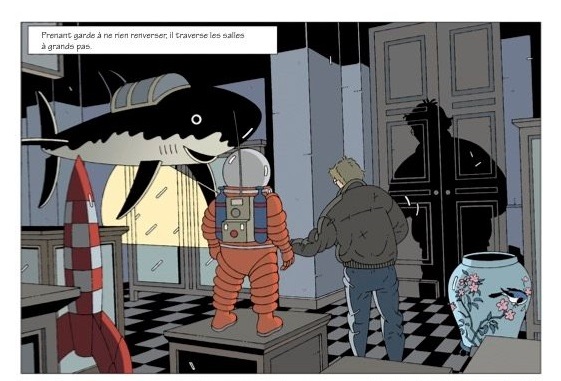
While writing this essay, I stumbled across some new information about the theft from the Palais des Beaux-Arts. This enabled me to complete my investigation, which can be found in the second part ofHergé and his fetish. As a supreme honour, the illustrator Alain Goffin has recoloured, exclusively for my book, a short comic strip from 1989 that he designed with Benoît Peeters.
And there's more to come! A friend of mine, also a Hergé specialist, recalled an anecdote while leafing through my book. He'll no doubt be writing about it soon. Tintinology is definitely an inexhaustible source of enigmas and discoveries!
Patrice GUERIN